Why traders still pick MT4 over newer platforms
MetaQuotes site stopped issuing new MT4 licences some time ago, pushing brokers toward MT5. Still, most retail forex traders haven't moved. The reason is not complicated: MT4 has twenty years of muscle memory behind it. More than a decade's worth of custom indicators, Expert Advisors, and community scripts were built for MT4. Switching to MT5 means rewriting that entire library, and the majority of users can't justify the effort.
I spent time testing MT4 and MT5 side by side, and the gap is marginal for most strategies. MT5 has a few extras including more timeframes and a built-in economic calendar, but chart functionality is nearly identical. For most retail strategies, MT4 still holds its own.
Setting up MT4 without the usual headaches
Installation takes a few minutes. The part that trips people up is the setup after install. On first launch, MT4 loads with four charts tiled across one window. Shut them all and open just the pairs you care about.
Chart templates save time. Configure your go-to indicators once, then save it as a template. After that you can apply it to any new chart without redoing the work. Small thing, but over months it adds up.
One setting worth changing: open Tools > Options > Charts and tick "Show ask line." The default view is the bid price by default, which makes buy entries seem misaligned until you realise the ask price is hidden.
How reliable is MT4 backtesting?
MT4's built-in strategy tester lets you run Expert Advisors against historical data. Worth noting though: the reliability of those results depends entirely on your tick data. Built-in history data is modelled, meaning it fills in missing ticks mathematically. For anything more precise than a quick look, download proper historical data.
That quality percentage in the results tells you more than the profit figure. Below 90% indicates the results shouldn't be taken seriously. Traders sometimes post backtest results with 25% modelling quality and wonder why their live results don't match.
The strategy tester is one of MT4's stronger features, but it's only as good as the data you give it.
Custom indicators on MT4: worth the effort?
MT4 ships with 30 standard technical indicators. The average trader uses maybe a handful. That said, where MT4 gets interesting comes from user-built indicators coded in MQL4. The MQL5 marketplace alone has over 2,000 options, covering everything from tweaked versions of standard tools to complex multi-timeframe dashboards.
Installing them is straightforward: drop the .ex4 or .mq4 file into your MQL4/Indicators folder, restart MT4, and it appears in the Navigator panel. One thing to watch is quality control. Free indicators vary wildly. A few are well coded and maintained. Some are abandoned projects and will crash your terminal.
If you're downloading custom indicators, look at when it was last updated and whether other traders mention bugs. A poorly written indicator won't just give wrong signals — it can freeze the whole terminal.
Risk management settings most MT4 traders ignore
MT4 has some risk management tools that the majority of users never configure. The most useful is maximum deviation in the new order panel. This defines how much slippage you're willing to tolerate on market orders. If you don't set it and you're accepting whatever price the broker gives you.
Stop losses go without saying, but trailing stops is worth exploring. Click on an open trade, select Trailing Stop, and define your preferred distance. It follows when the trade goes in your favour. Not perfect for every strategy, but if you're riding trends it takes away the need to stare at the screen.
You can configure all of this in under five minutes and the difference in discipline is noticeable over time.
EAs on MT4: what to realistically expect
Automated trading through Expert Advisors have obvious appeal: define your rules and let the machine execute. The reality is, a huge percentage of them fail to deliver over any decent time period. The ones marketed using flawless equity curves tend to be curve-fitted — they worked on historical data and fall apart once conditions shift.
None of this means all EAs are useless. Certain traders code custom EAs for one particular setup: opening trades at session opens, managing position sizing, or taking profit at fixed levels. These utility-type EAs tend to work because they execute mechanical tasks where you don't need judgment.
When looking at Expert Advisors, use a demo account for no less than two to three months. Live demo testing is more informative than backtesting alone.
MT4 beyond the desktop
The platform was designed for Windows. Running it on Mac face friction. The old method was Wine or PlayOnMac, which mostly worked but had display glitches and the odd crash. A few brokers now offer native Mac apps wrapped around Wine under the hood, which work more smoothly but still aren't true native apps.
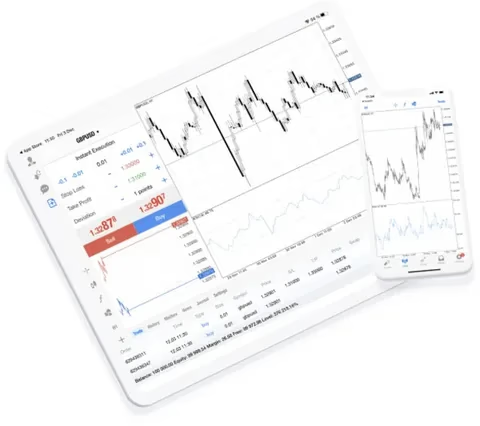
The mobile apps, on both Apple and Android devices, are surprisingly capable for keeping an eye on open trades and managing trades on the move. Serious charting work on a 5-inch screen isn't realistic, but managing exits from your phone has saved plenty of traders.
Look into whether your broker has a native Mac build or just a wrapper — the experience varies a lot between the two.